顯示具有 一些反思與FAQ 標籤的文章。 顯示所有文章

2016年7月4日 星期一

柬埔寨的第一場OPEN SPACE會議分享

跟大家分享一則OST經驗。摘譯自一位關注當地的藝術發展的柬埔寨朋友,向國際OPEN SPACE社群分享的一個OST故事。

我想找一個可以替換掉那由於長期的:依賴補助、政府貪腐、由上而下管理...而深深影響著我們的社會態度,即使是藝文界人士也無不陷入:錢要從那裡來?要等上面給我們策略指示才可以往前走。

所以我邀請了三個藝文界的領導人士成為我的合作夥伴:一位是畫廊老闆,同時也是藝術節的指揮;一個服務身心障礙者的藝術組織的資深管理人;以及一位負責Mozilla在地化的技術背景的經理人。然後我們再邀請所有我們認識的視覺和表演藝術工作者、建築師、影片製作、作家、技術等朋友,一起來參加一天的聚會,我們的主題是:"如何為我們的所愛做更多?How do we do more of what we love?"

等備期間,在柬埔寨生活和工作的人類學家友人跟我說:Khmer人不擅於為自己的行動負責,所以可能得用2-3天的工作坊,慢慢來介紹開放空間科技(OST)。我的協力主辦的夥伴之一也說:OST跟Khmer人習慣的互動模式是相衝突的...

然而這正是我想要引進OST的主要原因,我想知道這是否可以讓人們擺脫內建在大家身上的無力和無助感。


我的合作夥伴們都試圖調整OST的形式,如至少預先決定好一半要討論的主題、把先決定的題目加到OST的規則裡...在這一陣混亂中,Gail 很直接地提醒我:什麼才是OST,修正過後的過程就不再是OST了。然後一切雜音(包括我自己腦中的)才靜止下來。

整個"如何為我們的所愛做更多?How do we do more of what we love?"活動進行順利而成功。所有的藝文界朋友們(例如藝術教師、藝術經紀人、文化組織工作者)都很投入,結束圓圈時,有不少人說:他們以為開放空間指的是一個沒有屋頂的物理空間,現在懂了那指的是一個過程;來自服務身障朋友組織的經理人則對其中的自由感到驚喜;想要開影像學校的藝術老師則好奇一場開放空間可以有多少人參加;一位聰慧的大三學生則問OST還可以用在那些主題上;紐約來的劇場人想知道我從那學到這個手法...
會後,我的合作夥伴們完全被說服了,他們希望在未來的6個月內可以再辦另一場OST活動。

  • 照片與紀錄   https://goo.gl/E0Vfvi
  • 臉書上的照片  https://goo.gl/Zx5Eac
  • 在地媒體報導 (from a VOA student intern) http://www.voacambodia.com/a/a-gathering-to-let-creative-ideas-be-heard/3384065.html

謝謝所有OST社群朋友的分享,創造了這個不凡的經驗。期待未來我可以辦理更多藝文相關的OST,無論是在柬埔寨或其他地方。

發信人:IRENE S LEUNG PhD (culture as development)
​~~~~~~~~~~~~~~~~~~~~~~~~~~~~~~~~~~~~~~~~~~~~~

以下是OST的創始人 Harrison 的email 回應:

常常最大的問題是來自於引導師和主辦人,因為他們是如此地擔心:事情可能會失控!
所以就會想方設法,希望讓事情容易進行些,讓人們有所準備!
所以安排一暖身活動

...增加這些時段,的確讓引導師和主辦人覺得安心些,或許也增加一點引導師的酬勞.
但這些對於應邀而來的人(他們真正關切的是主題),增加這些對他們沒有什麼意義,甚且反成為積極參與的阻礙!

以上是我30年來在全球的經驗心得。
當然,我也不一定是對的!

謝謝分享這麼棒的故事。
​ ​
ho ​ Harrison​

2015年12月8日 星期二

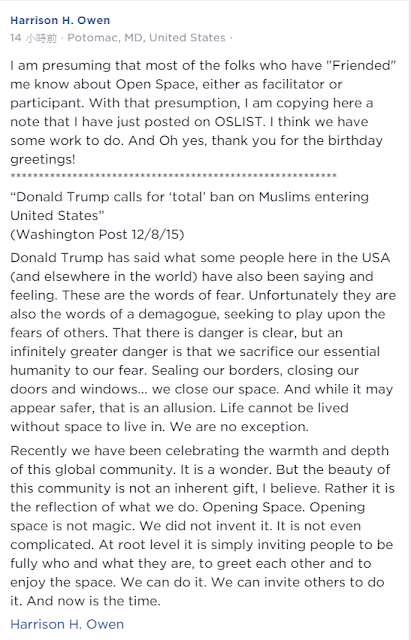
瑞典ost 社群邀請人們為難民開啟更多空間


兩則讓人感動的訊息:

瑞典開放空間社群的人們,呼籲全世界的人們一起來面對歐洲/全球難民危機議題。這是一個展現人性的機會,“如何在這個機會裡有最佳的表現?〞相信開放空間會帶出人們最好的一面,所以邀大家一起來。

OST people Calling For Action


幾個月來  Scandinavia 的ost朋友已每個月聚在一起互相激勵,探索對於大量新成員加入我們的鄰里、社區與國家過程裡,我們可以做些什麼行動來參與和貢獻。有些行動已經在進行了,未來會有更多...

不久前,才過完80歲生日的 Harrison Owen (Open Space Technology方法的創始人),也在他的臉書做了響應。他認為如果我們放棄人性而屈服於恐懼,封掉邊界、關起我們的門與窗,不就是在關掉空間!沒有空間人是沒辦法存活的,包括你我。

我們所愛的這個溫暖而深刻的開放空間社群 ,並不是憑空在那裡的,而是我們的所作所為的具體呈現;開放空間開啟空間並不是魔術、且一點也不複雜,最基礎的精神是:

邀請人們完完全全地呈展現自己,互相招呼、一起享受空間。
我們做得到、也可以邀請其他人一起這麼做。現在就開始吧!


Harrison Owen's Facebook

2014年8月1日 星期五

為什麼自我管理將很快取代傳統管理?

原文出處:Why Self-Management Will Soon Replace Management 
取自:Huffingtonpost.com, 7/16/2014
中文:ICA Taiwan, July ICA Trends

當我為我的新書《Igniting the Invisible Tribe激勵隱形的部落》時,我不經意地閱讀到蓋瑞‧哈默爾(Gary Hamel)的文章「先把所有的經理人員解聘 (First, Let's Fire All The Managers)」,刊登於2011年十一月的《哈佛商業管理》中的這篇文章,談到一家位於加州、做番茄加工的公司晨星(Morning Star),文章所提到的「自我管理」的公司的概念相當吸引我,但也讓我非常困惑。當時我就想,沒有領導者的組織該怎麼運作?感覺上非常不可思議。但是很明顯的,這不是難以想像的狀況。晨星是一個非常成功的企業,有上百位員工(在番茄盛產期間,有上千個員工)。這是全球最大的番茄加工公司,也就是說,各位一定吃過他們的產品。據說該公司每年營收超過七億美元,而且這樣的經營模式已經運作超過二十年。


這是怎麼一回事?或許更應該問的是,如果傳統的「管理」真的像哈默爾在文章中所說的無效能,為什麼自我管理還沒成為主流?

以下的三個理由說明為什麼「自我管理」的原則至今仍未成為組織結構中的一環,還有為什麼以後一定會(很快)。

1) 我們並沒有將自我管理想成一個實際的「結構」。

我們在思考組織結構的設計時,大多數的人想的是從上向下的等級結構。事實上,我們在規劃組織結構時,腦海裡已經填滿這種想法,除了傳統的金字塔結構之外,很多人想不出其他的畫面。

我們沒注意到的是,整個宇宙幾乎全是自我管理。我們身邊的大自然世界就反映出自我管理的狀態。就如晨星公司創辦人Chris Rufer在哈默爾的文章裡所說:「因為大氣層的狀況、溫度和濕氣的變化,讓水分子濃縮或蒸發,所以雲朵形成又消失。」大自然的世界一直調整和回應需求,繼續發揮功能。我們的組織為什麼不能也這樣做?

雖然自我管理的組織有一種特定的結構,但是和傳統組織做比較,就好像將古埃及法老王的古墓和天空的雲朵來做比較一樣。兩種組織都是依循特定的規則而創造出來,但是使用說明書的內容卻很不同。

在自我管理的狀態下,「結構」通常是一系列的原則,用來引導出(或防止)特定的行為模式。比方說,晨星的整個組織就是根據兩個原則架構起來:1) 沒有人比其他人更有權力,無法操弄其他人,2) 每個人都必須遵守他們對彼此的承諾。當然還有其它的規則,但是只要發揮一點點的想像力,就可以想像出,光是用這兩種原則,就可以大幅度重新塑造傳統組織的行事態度。

當我們的公司必須回應速度越來越快的市場,我們就會發現,那種從上向下的階級制度,感覺上越來越是一種累贅。我們日常的工作內容越來越複雜,所以我們必須用創意來強化我們的創新能力,但是我們的組織卻是在壓抑讓我們更創新的行為!我們需要找到方法,讓組織不要妨礙我們的工作,而自我管理的原則則是會讓我們大幅度強化創新的能力。

2) 我們覺得這個想法很新,還沒證實可行。

數千年的生物演化已經教我們對改變持著小心的態度。我們體內已經訓練好要辨識出環境中可能傷害我們的差異元素,所以也將「新的組織結構」放在這個項目中。這樣的原始反應的確可以幫助我們不被老虎吃掉,但是當我們面對一個可能會讓我們致命的環境時,這種小心的態度卻不怎麼好。

很多很多的研究都已經跟我們說,我們工作的方式並不是特別有效,我們需要很深層、有系統性的組織復興。或許我們覺得自我管理的原則太新,沒有足夠的證據可以證實它有效,只是因為我們待過的大多數的組織沒有採用這些原則。

在新出版的書籍《Reinventing Organizations (譯為重新發明組織,還有為自我組之機構所撰寫的一篇精湛的文章)中,作者Frederic Laloux 很清楚地說明這樣的誤解為什麼是錯的。他提供了許多的範例,如W. L. Gore、美國全食超市(Whole Foods)、維基百科、Patagonia、Orpheus 室內交響樂團、戒酒無名會(Alcoholics Anonymous)等等,很清楚地,自我組織的組織已經這樣操作好幾十年,至今也仍然相當成功。

除此之外,你可能就是證明這個概念其實有效的最好例子。想一想,你當出到底怎麼知道該跟誰約會、該和誰結婚?是誰跟你說什麼時候該生小孩?你的人生中,沒有經理人來幫你,那又是怎麼活下去的?
其實,你的人生有多長,就證明自我管理的概念有效有多久。

3) 我們很怕沒有經理人/領導者的組織的想法。

說實在的,這樣的恐懼完全沒有根據。多年來,我學習領導學,而且數十年的研究已經一再證明好的經理人/領導者的角色有多重要。那麼,沒有他們,自我管理的組織該怎麼辦?

最近我在講台現場採訪了晨星自我管理機構(Morning Star Self-Management Institute)的道格‧柯克帕特里克(Doug Kirkpatrick)。在訪問的開場時,我提到哈默爾的文章,對道格說的話有點像是:「現在在晨星裡並沒有任何的管理人員,請跟我說你如何辦到的。」他立刻糾正我:「我們有管理人員,公司裡的每一個人都是管理人員。」  那麼,組織沒有領導者該如何運作?短一點的答案是:這些組織不運作。和傳統組織不一樣的地方是,自我管理的組織中,人們不是因為別人「讓」他們變成領導者,而是他們決定要領導。誠信、影響力,和能夠說服對方的能力等基本上值得讓人追隨的特質,就是這些公司裡的領導者的特質。

如果我們的組織希望在未來的經濟體系下成功,就必須具備能夠讓好的點子呈現的機制。當下的組織的一些鬥爭和權力遊戲根本沒有生產出真正的價值,完全無助於顧客的生活。我們的組織必須找出能夠激發出真正具領導力的行為模式的方法,而自我管理的做法,就是最能激發出這種能力的方法。

 
本文是Huffington Post Great Work Cultures系列合作推出的系列文章之一,後者正創造一種新的企業文化的模式,促進更有效的效能、讓人們更快樂。

2013年9月13日 星期五

開放空間會議 + 大學教授 = 突破困境開展未來?

by Ito Chao

因著外在環境的劇烈變化,近年許多大學教授越來越忙,同事間的交流隨之減少。雖堅守崗位,越忙越茫者所在多有,好不辛苦。但是每個系所必須與時俱進,沒有團體的智慧與力量,單靠單位主管在日趨複雜的環境中苦撐著,幾乎是mission impossible。不少主管都是帶著挫折感下台,菁英們就這樣耗損著。


自從聽說open space technology可以促進對話、凝結團體智慧與熱情,去年暑假帶著無限好奇去參加了學習工作坊,發現這個簡單又不簡單、把所有人放在平等地位的方法,對自主性原本就高的教授而言,的確有可能帶來對話與連結。

今年農曆過年前,說服所裡主管與同仁,在大家的"心"最不忙的時刻舉辦開放空間會議。就這樣,一群帶著狐疑的教授們,在八個小時的會議中,發現這個未事先訂定議程的會議,在淑芳與Gail的引導下,並未出現想像中的混亂場景。藉著討論自己關心的議題,不但讓個人有打開視野與找到同志的感覺,許多事情的解決方案,自然地在對話激盪出的靈光中浮現出來;對於需要更長時間對話的議題,在當下也建立了很好的討論基礎。


另一方面,我們發現事先其實很難猜測哪些人會對什麼議題有興趣,經過這些對話,我們對事、對同事都更瞭解了!


這個暑假,在大學心理系任教的朋友Wen找上淑芳,探詢系上的retreat是否可以跳脫一般的會議手法。沒想到這兩整天的retreat,在淑芳的鼓勵下,成了我由"參加者"轉變為"引導者"的破天荒第一遭。

過程中跟Gail學了很多,尤其讚嘆她敏銳的覺察與聯想力,利用大家這兩天的共同經歷,那怕是一個只出現了十分鐘的小女孩,或者是在開會地點看到的大鐘,她自然地引申出簡短的洞見,在毫無說教意味的氣氛下,讓大家看到這場會議可以產生的意涵與影響,而更加投入。能夠跟無時無刻都在思考如何可以讓這個團體更加凝聚的引導大師共事,實在太幸運了!雖然會議引導師說話的時間非常少,但這樣的用心,讓會議引導有了不同的層次。

2013年8月8日 星期四

1,000 participants in 4 hours - The Report

菲律賓的好朋友 Sharon Joy Berlin Chao 七月受邀引導一場特別的open space,四小時內讓 1100多人一起討論。以下是她會後整理的一些過程與心得,貼出來跟大家分享。

Just two weeks ago I had this interesting experience of opening space for 1,100 (yes, the number swelled) under 4 hours. You probably remember the massive exchange in OSList on how to convene under these conditions as we burned the line talking about the merit of this assignment. The extent of our discussion was remarkable for it showed the depth of wisdom and passion attached to the practice with ideas flying from one side of the globe to the other. 

It started with an invitation to a two-day symposium on performance management system in government service. And because it’s a symposium there were 6 speakers lined up including a dozen others for concurrent sessions. Day 1 had a couple of plenary and concurrent sessions. Open Space was slated in the morning of Day 2 followed by a formal symposium integration and closure in the afternoon. This was the first time HR people in government are called together, and there was a good mix of people from national agencies, government corporations, state universities and local government units in attendance.

The open space session focused on making performance management system (PMS) in public service truly essential, responsive and life giving. Sitting through Day 1 presentations and forums made me realize that the audience have compelling stories to tell in addition to having contending views on how to move PMS in their agency. This prompted me to check my own motivation as I worked with government in the past and I know that PMS has always been a thorny issue in the service. I need to bring respect to everyone involved and there’s no sense adding my own ideas and arrogance to the issue.

Bits and pieces of the process I used that somehow worked despite the number and the time configuration:


·        Space was tight to include provision of an open space in the middle, but the hotel staff did an incredible job of assembling 5 layers of chairs in concentric circle. With this arrangement a thousand chairs almost reached the wall but then again that’s fine as there was ample space for people to move in the center. To facilitate movement an open aisle was provided from four points of the room so what we actually had was an open circle.

·        Opening was limited to an hour with 15-minute sponsorship and a walkthrough of the theme and the OST process. The whole spiel gave me time to completely/slowly walk the circle to establish some degree of proximity with the participants. The rest of the hour was spent getting people to queue and publicly announce their topics.

·        Convenors used placards (illustration board stapled on three-foot bamboo stick) instead of papers to publish their topics. There was no marketplace because the market was mobile. It was messy, disorderly and fun when convenors started to go around the room for membership, while the rest decide which topic to join. The decision to use placards was brought about by hotel’s policy not to stick anything on the wall, and this policy actually worked to everyone’s advantage.

·        It helped to talk about chaos openly and early on. There’s no way I can manage a thousand in four hours; and the only other thing left was expect chaos, accept it, and work it to my advantage. At the same time I remained calm and secure despite the seeming disarray inside the room especially when people start standing up and moving into groups. It’s essential to coach the sponsor to expect it. The analogy I used to convince them was that of a  wedding event, one can think things through and organize it to death but then again things don’t usually turn out as planned. I also told the participants to expect chaos, learn to live with the mess and love it.

·        When all the topics were declared (about a hundred), I realize it did not make sense sticking to the original plan of having two one-hour session, despite the color coded placards and instructions for groups to have two separate time frames. With placards on hand, people immediately self organized. Not even those sticky numbers posted (yes, this was the only concession we got from the hotel) made sense at this point. Respecting that tendency, I decided not to call for two sessions but instead do a two-hour session on the topics generated. This two hour event gave convenors ample time not only to convene their group and discuss the topic but also time to review and enrich the report.

·        Wonderful suggestion never to let go of the microphone especially during the queuing for topics and the closing of circle when a drove wanted to speak. We apportioned an hour for closing the circle, with about 20 people sharing their thoughts on the process and how they plan to move forward with PMS in their agency.

·        What worked for me in closing the circle was having someone to anchor it and in this case it was the Chair of the Civil Service Commission. This was very strategic as one can’t get any higher than this guy. Commitments were made on the results of the OS discussion including the commitment to  hold an annual gathering of HR people in public service.

·        I worked with one other friend in convening the circle. Having one person to do the walk is fine but it’s important to have someone to help hold the space with me, someone to ground me and to help make sense of the pulse of those in the circle which can easily be missed when one is caught up with things.

·        I remember Harrison saying that opening spaces is a dance and we can dance beautifully yet we should not be caught in it (I added some words here, not sure if he agrees). It’s this balancing act that keeps me grounded and calm but also allowed me to gently take rein of things when necessary to secure the space, and it worked especially in opening and closing of the space. In the end, OST became an act of accepting whatever comes and letting go whatever goes.

Preparing the self or what works for me two weeks ago:

·        I learn to love the mess and expect that nothing can be completely accounted for. I talk about it with the organizers, cue people who are in the circle and most importantly I embrace it like a mother embraces a child and just let it be without losing myself to it.

·        I learn to connect...I am passionate about this assignment as I worked with government for 14 years before joining my present job. There was deep connection between my need to serve and the intention of this gathering, and this was instructive in the way I prepared myself for the assignment. I drew strength from my love of government service, that I did not worry myself senseless unlike my previous OS engagements. I eased up and just refused to get caught in the usual pre-work worries. Don’t get me wrong pre-work is important and I’m glad I had a group of young women backing me on the details. But at the personal level, this engagement was unique as I dig deep and spend more time settling down. I also had a good night rest before opening the circle, so unlike the past. And there was a conscious attempt to stop talking the night before, not only outside but also inside. I practiced noble silence, ending the talk from the mouth and the mind. This is graceful silence and a very powerful one, it’s the silence that heals and nourishes, same energy I brought to the circle the next day.

·        I learn to hack my way through and think on my feet. The ways of OST never fail to surprise me, it served me on what I know would work yet  there’s no one way. I learn that there are many possible ways of moving forward, and it is by challenging and provoking what I already know that helps. What is universal and unchanging, what stays are the principles and the law, in whatever arrangements or configuration these are the things that stick. The rest is as experimental as catching the wave.

·        I learn to stay humble and step back from a prescribed program that’s already agreed upon but at the same time fearless despite what others say because in the end it's also about that one solitary person in the middle of the circle. It’s important to be open to the flow and to feel one’s way through the crowd, just as we do in real life.
_________________

For better appreciation of this experience, I’ve uploaded some photos in my Facebook account.

2013年3月27日 星期三

祇有開放性的資訊不一定帶來改變


FROM: tedxtaipei.com margaret_heffernan


...當你在組別裡發表自己的意見時,你希望聽到組員說:「對對對,好好好,是是是,我也這麼覺得。」還是:「你的想法很好,但是有些地方我不認同…」或許別人的想法不一定對,但你總有聽過「良藥苦口」吧!我們來看看Margaret Heffernan給大家建擁有設性矛盾的建議:

1. 找到和我們大不相同的人
2. 和擁有不同背景、不同教養、不同思考方法和不同經驗的人們進行交流
3. 做好改變自己的準備!

-----------------------------
覺得這個演講所要表達的,也是開放空間會議想要創造的環境,讓不同的人可以對話,創造說實話的空間、讓多元的聲音可以呈現。所以放在這裡給大家參考。

(閱讀全文


2013年3月11日 星期一

四大原則vs印度靈性教導


在臉書讀到的一段文字,拿來跟開放空間的四大原則做相互思考挺有意思。一個朋友Logan Hsu在 2011年把他們翻譯成中文,轉貼於下,跟大家分享。

印度靈性教導中有四句話說得非常棒:

1. 無論你遇見誰,他都是對的人。
這意味,沒有人是因為偶然進入我們的生命。每個在我們周圍,和我們有互動的人,都代表一些事。也許要教會我們什麼,也許要協助我們改善眼前的一個情況。

2. 無論發生什麼事,那都是唯一會發生的事。

我們所經歷的事,不可能,絕不可能以其他的方式發生,即便是最不重要的細節也不會。並不存在「要是我當時做法不一樣…那麼結果就會不一樣。」。無論 發生什麼事,那都是唯一會發生的,而且一定要那樣發生,才能讓我們學到經驗,以便繼續前進。生命中,我們經驗的每一種情境都是絕對完美的,即便它不符我們的理解與自尊。

3.不管事情開始於哪個時刻,都是對的時刻。

每一件事都正好是在對的時刻開始的,不早也不晚。當我們準備好,準備經歷生命中的新奇時刻,它就在哪裡,隨時準備開始。

4.已經結束的,已經結束了。

這是如此簡單。當生命中有些事情結束了,它會幫助我們進化。這是為什麼,要完整享受已然發生的事,最好是放下並持續前進。

此時你坐在這裡,讀著這些文字,這絕非巧合。如果這些文字觸動你的心弦,那是因為你的因緣成熟,你明白沒有任何一片雪花會因為意外落在錯的地方。


2011年7月5日 星期二

我所引導的第一場Open Space

在6/11--6/12的Open space學習工作坊後一個月,我們的參與者之一Jimmy實際引導了一場open space會議,以下是他會後給工作坊同仁的email的分享,以及來自Gail的回應。
~~~~~~~~~~~~~~~~~~~~~~~~~~~~~~~
dear All,
趁著記憶猶新,上週五我進行了人生第一場當做Open Space引導師的角色。對象是某某公司,因為他們面臨到緊急的重大危機,一週內會損失公司一半的財源
Last Friday, I have my first open space for my previous company. It's because they face the emergent situation that in 1 week, they will face to serious financial problem.

會議的效果很好,從上午11:00一直進行到晚上9:00。不過會議進行中,我有許多實務上的問題想要請問大家
The feedback is very well after the open space. We process this event from 10:00 to 21:00.
But I still have many practice question got to ask others opinions.


1. 如何面對討論者「離題」?  (What can I do when the group discussion is not focus on the main theme or subject of the group? )
在分組討論時,有些朋友會抒發跟討論組主題無關的心中感受。我直覺是重要的問題,且沒有介入中斷,但這樣做是好的嗎?大家又如何面對?

2. 如何面對討論超時?( What can we do when group discussion is overtime, and they still going on even if they have many other subject on the wall?)
session 1 / session 2 / session 3時段之間會劃分,但是大家並不會自動切換,有時還欲罷不能

3. 如何「消化」主題? ( In the beginning, we invite everyone to provide the subject to let everybody can join the discussion. But After the session going, I found that we never have time to discussion all of the subject. What can I do in this situation?)
討論主題太多時,且時間不斷進行中,會發覺大家根本沒時間討論這些主題。請問這個時候該怎麼辦?

4. 如何收尾 (Although we have the ending circle, and everybody provide the change of today. But I think facilitator may need to say something. I think I don't have good ending. Still need to hear someone's input.)

暫時想到這些,也借此問題一堆的信件,問候、謝謝各位當時的陪伴!

~~~~~~~~~~~~~~~~~~~~~~~~~~~~~~~~~~~~~~~~~~~~~~~~~~~~~
Reply from Gail:

Thank you and congratulations on your wonderful success!  Open Space was obviously the process they were ready for and needed in their current situation!  It worked and sounds like they will continue the conversations and figure out what they need to do.  Perhaps you can help them to reflect on the learnings and how to keep the space open so they continue to work in this way.

As for your questions – I don’t know any OS practitioner, no matter how much experience they have, who doesn’t have questions after a program wondering what they can do to improve their own skills and maybe what they might have done to make it “better”.  My answer is – what you did at the moment was the right thing for the group – and the comments at the closing indicate that!

For the specific questions:
1.      The topics people put up are all related to the theme.  I may not see the connection, but they did and felt it was something that needed to be discussed, so trust the group’s wisdom.  I (as the facilitator) may not know and don’t need to know or make a judgment about it.  (not so easy when you have worked for the company and know a lot about it!)
2.      I tell the group after they have up all of their topics and begin their groups, that we will meet back at a certain time to do the closing, so getting all of the topics discussed in small groups is up to them.  Sometimes a few topics get merged in with other topics, and some don’t get discussed formally or fully, but they have probably been discussed in some way. Or maybe they decide to talk about it at a later time.  Sometimes I will remind them of the closing time about 45 minutes before the time to meet back just in case they want to make sure their topics are discussed even for a short time.
3.      In the closing I might say something like – “for some of your topics the discussion may be over.  For others the conversations will continue on.  But for today, since our time is limited, we’ll do our closing and then you can continue however you choose.  Again – you don’t need to worry.  Trust them to do what they need to.
4.      In the closing, their comments are what is needed.  You may only say something as simple as “thank  you”

Again – thanks for sharing.  Can you share a little more about how you did your prework, number of participants, actions?

I’m sure others might also be able to add reflections for us all.  I look forward to more great stories!
~~~~~~~~~~~~~~~~~~~~~~~~~~~~~~~~~~~~~~~~~~~~~~~~~~~~~~~~~~
更多關於該場開放空間會議細節的分享:(More sharing about the open space event)

舉辦的時間非常緊急,因為討論時已經是6/30,但7/1許多員工就面臨到薪資問題,所以最後決定最好的時間就是7/1。
又因為7/2-7/3是週末假期,拖的時間越久,人心可能浮動越高。
The preparing is very urgent. When we discuss the subject and open space, it's is 6/30. But when 7/1, everybody will effect in the financial problem. And at last, we decide the best time is have an open space in 7/1.
By the way, 7/2 and 7/3 is weekend. We don't want the employee have such a bad feeling that company doesn't take any action to let them die. So the best time is 7/1.

但是因為非常匆促,場地選的不好,沒有很大的空間,雖然大家可以隨意移動,但彼此干擾。參加者大約23位,空間大概可容納30-35位。有了這次經驗,我未來會選擇正方形、兩倍人數的空間,好讓會議可以順利進行。
I feel the location is very important after this open space. I ignore such an important thing that I choose the smaller but easier solution for this open space. We have 23 participants and the room can have 30-32 people. But after this experience, in the future, I'll plan to rent double - triple space of participants. Then the people can through and discussion more easily.

我覺得這次主題定的很不錯,因為之前就有練習過,所以主題的定義算是滿能讓人感到參與這個會議是興奮的。主題是:
「新方向:如何與公司共同創造人生的下一步?」
I think the subject is very good. It's because we have practice in the course. The subject is:
「New direction: How to initiate your life with our company?

Action,很神奇的是當整個討論結束時,Action已經自然形成。
I think the action is appear naturally. Maybe after the group have enough power to face the problem, they will find the correct direction naturally.


2009年12月25日 星期五

領導力活動紀錄~university/community leadership program

USF SP M Wheatley Leadership Series


分享這個活動故事的Suzanne Daigle ,特別提到〞要改變世界,要創造真正的熱情和行動,真的需要時間,…〞 這好像也是我們在台灣推動參與式討論、參與式決策和行動,也常常碰到的挑戰,共勉。

I realized that to change a world, create real passion, drive action requires time: time to connect, time to discover, time to think, to share and to celebrate, to trust and to take personal responsibility. 


2009年12月10日 星期四

一些經驗分享


之前從網路上看到有一場會是打算用開放空間會議方式來進行的,可是活動資料裡沒看到〞主題〞或者引導師,而且一天的活動是有既定議程的。

剛好有空,所以就去現場看看有沒有可以幫上忙的地方。因為我總是鼓勵大家嘗試去運用open space,我相信自己操作過後,會有不同的學習和體會。

每一個會都會因參與者的投入,而有不同的產出,這個會也一樣,參加的人或許不多,會議的進行準備或許不怎麼像我所熟悉的open space,但與會者仍創造出屬於他們的對話和行動方案。

我想趁此機會整理幾點我擔任引導師的心得,跟大家分享。


  • OST(開放空間會議)是一個會議過程,本身不是目的。會議還是要問:為什麼要開會?想達到什麼目的?這方法的進行過程是很簡單的,需要較多心力處理的反是:會前的準備和規劃。先釐清召集會議所要達到的目標,再來尋找適合的方法或過程,是較適合的。
  • OST的〞主題〞非常重要,找到是一個大家所關心、有意願和動機來討論的issue,然後依此定一個可以涵蓋大家關注方向的主題。事先的討論和對會議的期待澄清是會議能否成功的關鍵。如果受邀當引導師,我們通常會花一些時間做訪談、再看是否適合ost?並協助主辦人找到適合的〞主題〞,再發出邀請函。
  • 不宜同時擔任主持人和引導師。以免造成參與者的混淆。
  • 一般OST的進行,不做任何自我介紹和暖身的動作,人們在互動中會去互相認識的。人們接到邀請函而來,目的是對主題有更深更廣的討論,所以我們建議直接進入會議。
  • OST的過程很簡單,但有幾個安排很重要。如新聞牆,第一階段討論結束後,看到不同組的報告貼出來,對參與者有很不一樣的意義。會引發進一步的參與。
  • OST很強調自由和自我負責。所以雙腳法則適用於每個與會者,包括議題的發起人,不適合對此做限制。也不鼓勵事先指定各小組的主持人,應把參與的責任和選擇完全交付給與會者決定。
  • 如果主辦人希望有多一點的引導和結構,才能幫助大家進入討論,那OST可能不是你要的過程,有其他方法可以達到你們會議目標。
少了事先的釐清和準備過程,或者加進過多的引導主持過程,OST很容易就成了所謂的腦力激盪,或者很愉快的一場談話而已,雖然也沒有什麼不好,祇是我會覺得有點可惜。小小心得跟大家分享。(我是開拓文教基金會的蔡淑芳)


2009年3月16日 星期一

開放空間會議後~一個社造工作者的心聲

OST_meeting of Taitung,Taiwan

~會議開始前,引導師建議大家先針對當天的主題再討論一下,是否是大家有熱情也覺得迫切的議題。~

12月13-14日這兩天又邀集到約二十位朋友來參與,大家花了一些時間討論這兩天我們想談什麼,雖說如何推動文化生活圈是邀請函上的主題,但是還是認為這個題目給它大了點,也對多數人還是陌生,最後決定先由李科長和我先為大家介紹明年文觀處將如何推動文化生活圈,其中有哪些事情是文觀處做不到的,是否NGO 可以做;反之,NGO需要協助的,gov可以怎麼幫。如此,題目就產生了:「互助‧互惠」。

這幾年來,參與社區營造的培力工作時,深深感受到社區參與公共事務的冷淡,有些地方甚至出現排斥的狀況,問題之一是開會的方式令人畏懼,許多推動社區工作的問題,出於缺乏談事情的耐心和空間。

在參與第一場開放空間會議之後,發覺這是我一直想改善開會的解決方法嗎?社區會議可以這樣開嗎?類似文化生活圈的地區性的共識會議也能這樣的辦嗎?其實,遇到這種癥結心裡頭很明白,誰叫我這麼雞婆把這玩意兒引進台東?沒有人!真的是處在頭髮洗一半,擔心沒水的情境。

不過,在這次第二天會議快結束時,出現意想不到的情況,鹿野的廖中勳以及太麻里的鄭振興,兩位仁兄希望將這樣的會議引進兩地舉行,1月10、11日分別在太麻里和鹿野各辦一場。心裡真是暗爽許久,百感交加呀!開始覺得好玩又不累的社造工作,才正要開始呢。

接續的是第二場的會議記錄,議題沒第一場多,不過字數卻多到我多花一天來打字。各位可以繼續發表意見,空間是開放的。

換個角度想一想這些紀錄,好像開始有點文化資產的味道耶,集體的智慧累積,不是嗎?

轉貼自來自台東的社造雜記

主辦人(sponsor)的感言

IMG_2009.jpg

開放空間科技“對於領導人及參與者而言,都有重要的意義與功能。

   1962年『古巴飛彈危機』期間,美國總甘乃廸決定封鎖己經佈置蘇聯核武器的古巴,並對引發危機的蘇聯發出最後通碟,幾經波折,最後蘇聯將核子武器撤出 古巴,危機順利解決。然而甘乃廸總統事後評論他的決策過程,他認為他是“在黑暗中作決定”,也就是說他是在資訊不足的情況下,僥幸的解決了問題!這點出了 領導人通常被迫在資訊不足、各種可能性未被完整評估,以及高時間壓力中,必需作出影響重大的決定,真是太辛苦、不合理,也太危險!


  個人認為,「開放空間會議」很大的程度解決了以往不合理的權力框架問題,在基本結構上翻轉困境,讓參與者在開放空間這個平台上,投入熱情、才華,並形成行動 方案,讓事情順勢往好的方向發展。對於領導人而言,可以藉由開放空間會議技術,收集各種可能性,並且形成行動團隊,有助於事情的解決與發展。另外,這種注重參與的開會技術,實質上也是一種責任與義務的參與分享,幫助組織更有凝聚力與行動力,也解開領導人被期望成為「全能者」的不合理期待。

  對於其他參與者而言,基本上這個過程,就是一種參與分享合作,是重要的公民訓練,也是讓參與者從“關係人”轉換成“熱情的當事人”的過 程。這種技術可以運用的範圍很廣,尤其是筆者所從事的社區營造工作,開放空間科技更是改變以往由意見領袖、公部門、專家學者單向領導,居民反成配角,通常 只低度參與的困境,轉而引發居民熱情參與,並且立即行動的良策。

  初步接觸開放空間會議,就覺得這是非常實際有用的技術,未來希望精進這方面知能,讓更多人、更多團體、更多地方、更多事情,有好的發展。

2007年10月17日 星期三

★從〞需要〞出發

samp1d12ba72fdd25c6e.jpg
網路上的開放空間會議分享郵件,傳來一些很棒的分享,轉貼如下:
特別喜歡:For me, need is the seed of invitation. No need,
no invitation. No invitation, no space to open.

因為有需要,所以邀請;沒有需要,就沒有邀請;沒有邀請,何來可發展的空間!
*******************************************
I am a 16 year old student in the Québec City. I
have just recently moved here from New Zealand.
I am very very interested in open space technology.


My observations on Open space would be...

People who show up need to be fully
participating, I have experienced it when people
are not and i find the meeting is dead and going
no where.

We have opened space for kids between the ages of
10 and 18 years for a Creative Space we owned in
NZ and have found it very difficult at times but
have kept doing it resulting in them or (some)
of them finally getting it - which when they do
understand it is brilliant...

I was part of opening space for about 200 people
which were part of a government organisation and
thought it was great. I enjoy it a lot when
people break off into several different spaces
and you can drift from one interesting
conversation to another.
Niko Lebel
*****************************
Thanks for your observations on opening space.
We're working a fair amount with youth and kids
too, and I can't emphasize enough the importance
of getting the theme right. Open Space is
fabulous when it addresses a real and pressing
need. Youth in open space are great testers of
whether you have the initial conditions right.
In a small space as well, you will discover quite
quickly how pressing the need is.

For me, need is the seed of invitation. No need,
no invitation. No invitation, no space to open.


Chris Corregan

2007年7月23日 星期一

★又一場不同的學習經驗

CIMG1555.JPG

My thanks to all of you for creating such a wonderful learning in two days together.  Even with the high temperature and spending the entire weekend indoors, it is fun to be with people who have such passion for making a difference in their own lives, social and work relationships.  I look forward to what happens next.       (Gail ,ICA)
這一次的學習工坊,有一些些辛苦,大家在台北最熱的時候碰到空調有狀況,然而經由互動分享所獲得的學習,依然動人。


有人說:原以為我都知道了、懂了,怎麼到練習時,發現好像不是那麼回事;
第二天沒能來參加的芬,在msn上說:雖然祇參加了一半,也覺很有收獲。

而回到高雄的慧email上說:覺得兩天下來,我更覺察到這個方法背後善意;和呼應自然運行的精神;我還在慢慢體會消化,不過在路上的感受是興奮的,因為知道隨時可以迎接驚喜…

work togetherpostersexperiencing ostsmall group discussionconvergencedrama1
drama2reflectionwe invite you...we welcome you ...integraingQ&A time
ost learning workshop2007, a set on Flickr.

相關活動:2006 ost學習工作坊

2006年9月10日 星期日

★一場生命的交流--記ost學習工作坊


共度二天的伙伴

周末,15個同伴聚在一起學習、分享開放空間會議的一切:技巧、精神、本質,體驗也練習如何進行一場有感覺的開放空間會議。探索、連結、分享,過了輕鬆而豐富的二天。

經過多次的經驗後,我們決定不再稱這個為課程或訓練,而是邀請大家一起來互相分享探索的一個學習工作坊。

OST是一個自然而簡單的過程,嚴格說來沒有太多的技巧,比較像是對生命的態度、對人的信任、對人跟人相處的信念。看到同伴們分享的表情、被觸動的感覺,自己好像也跟著安靜了下來。


在這個學習過程裡,從自己的經驗出發,去探索什麼是四大原則

1. 出席的人都是最適當的(whoever come is the right people)

2. 不管何時開始都是最適當的時間(whenever it starts is the right time)
3. 不管發生什麼,都是當時只能發生的事(Whatever happen is the only thing that could have)

4. 結束的時候就結束了(When it's over,it's over)
以及「雙腳法則」(The Law of two feet)到底在說什麼?

每個人都可以在自己的生命裡找到相對應的經驗。


隨著討論、練習、分享,大家臉上的表情越來越溫柔,
出現了許多的〞原來如此〞,〞是這樣啊〞,是領悟的喜悅和滿足。

很少有二天的學習課程,讓人離開時是豐富卻也是輕鬆的;
而且感受到人跟人之間的連結是那麼地容易、又那麼地重要;
我好像再次被淨化了,並充滿了新能量。

我喜歡Gail說的:世界會因為我們共渡這二天而不再一樣!

更多照片

2006年8月10日 星期四

★開放空間會議可以讓Bin Laden不一樣嗎?


開放空間會議網路社群裡,常常有很精彩的對話,在一問一答間,帶出OST的精神;也在問和答的對話過程中,將不同角落的人們串連了起來。這個網路社群是Harrson Owen等OST的先驅者,多年來同心協力所帶動起來的一個全球的分享討論社群,任何人祇要有興趣都可參與。
這一則對話是Harrison分享了一個朋友寫給他的談論對中東戰場傷害無辜者的痛心,人們分享了一些對戰爭的想法。社群裡有人提出對於〞OST可以打開善的空間〞的質疑,以及Harrison的回應,讓我看了非常心動,所以翻成中文跟大家分享。


Dania是Harrison Owen在一場「猶太人祭司和什葉派領導者」會議中所認識的一個來自印尼的年輕女孩,Harrison將他們的email往返內容跟大家做分享,並帶來一些回響跟對談。

(摘要)
我很關心黎巴嫩境內的以色列和真主黨之間的戰爭,因到處都看得到報導,看到死傷者多數是兒童跟老人、住宅建築被轟炸,人們深受其苦…無處不在的新聞,讓我無處可逃。
收音機的新聞後,電台放了一首我所喜愛的歌(imagine),二個不同的歌手分別以阿拉伯文、法文、英文唱這首歌。
這首歌我聽過無數次,但昨天我忍不住哭了…這個戰爭跟一切讓我難過極了,這個世界出了什麼問題?他們為什麼這麼做?為什麼他們不停戰,和平快樂地一起生活?和平有什麼不好?他們幹嘛不要?他們到底想要什麼?所有這一切何時才會結束?
我們可以做些什麼讓戰爭停止嗎?你、我和所有那些參加西班牙那場會議的宗教領導者們,我們不能做些什麼行動來讓戰爭停止嗎?我們不能做些什麼讓他們了解戰爭對誰都沒有好處嗎?
我找不到答案,我覺得好無助。

Dania wrote:

Dear Mr. Owen,
How are you? I'm Dania from Indonesia. I was a participant of the world
congress of Imams and Rabbis for Peace in Seville, Spain, as a student of
Children of Abraham. I met you there. I hope you're still remember me
Mr. Owen, I'm very concerned about the war between Hezbollah and Israel in
Lebanon.. I read the news about it everywhere. Yesterday, I found a
newspaper on my boss' desk. I stole it (hihihihi) while she was having lunch
and read the news about Hezbollah and Israel. People died in Lebanon, most
of them are children and old people. They bombed houses, buildings.. oh my
God, I couldn't stand read it. I saw the news on the TV, too. They showed
the picture of the victims in lebanon, the children, the amunitions, people
suffered...
On my way back home from the office, I turned my radio on and heard the news
about Hezbollah and Israel (again and again and again!).after the news, they
played one of my favourite songs, Imagine, sang by 2 singers, an arabic man
and a french woman. they sang the song in 3 languages: arabic, french, and
english. it was beautiful. i've heard this song many times, but when I heard
it yesterday, I cried.. I was very upset about this war and all. whjat is
wrong with this world?? why do they do that? what for? Can't they stop the
war, make peace, and live happily together? what's wrong with peace? why do
they reject peace? what do they want now? when is it going to be over?
Can we do something to stop the war, Mr. Owen? Me, you, and the Imams and
Rabbis who attended the congress in Seville? Can we take action? What can we
do to stop the war? what can we do to make them realize that war won't do
any good?
I can't find any answer for these questions.. I feel hopeless.

Dania

Harrison的回答

我對你的印像很深刻。
對你所說的真主黨和以色列之間的…
我想這件事是人類歷史上的遺憾時刻之一,
許多事我們該做卻沒有去做;加上許多我們不該做卻做了的事--在發生效應。

就好像我們沒有好好照顧自己的健康,突然發現自己被感染而發燒了,發燒有一定的過程要經歷,燒早晚是會退的,祇是不知道燒是否會在造成重大傷害前就褪去,仍待觀察。

當人,是一個持續的學習過程,有時這個學習可能是很痛苦的,人類最大的悲劇是不學習。所以,我並不會覺得無助或沒有希望,我當然沒有辦法去拉開真主黨和以色列,我也不認為那些認為自己有辦法做到的人(總統、國王、祭司、什葉派領袖等)就做的比我好。即使他們在黎巴嫩成功了----潛在的因素沒有消解掉,有一天還會再發起燒來的。所以,怎麼辦呢?
我,打算繼續去打開空間,讓像你這麼棒的人可以浸潤在你所說的〞遊戲場〞裡,在裡面,真的人、不同的人會互相尊重,如果你也想做些什麼,歡迎你也來加入這打開空間的行列。

I replied:
Of course I remember you! And with great affection!! As for Hezbollah and
Isreal. . . I am afraid that this may be one of those times in Human history
when all the things we should done and did not, along with all the things we
should not have done and did -- now come due. It is rather like the
situation when we do not take care of our health and suddenly we find that
we have a bad infection and a fever. That fever will now run it's course.
Sooner or later it will break but whether that break occurs before major
damage has been done, or after, remains to be seen. Being a Human Being is a
constant learning process, and sometimes that learning can be very painful.
But the greatest tragedy would be not to learn. So for my self, I feel
neither helpless nor hopeless. To be sure I do not have the power to
separate Israel and Hezbollah, nor do I think that those who may think they
have the power (Presidents, Kings, Imams, Rabbis, etc) could do any better.
And even if they were to be successful in Lebanon -- the underlying causes
would remain, and the fever would break out again. So what to do? Speaking
only for my self, I intend to keep opening space so that wonderful people
such as you can experience that "playground" (as you called it) in which
real people with real differences can meet each other with respect. And if
you are looking for something to do right now -- you could try the same
thing.

God Luck! And thank you for remembering me!!

Harrison

**********************************************************

跟著Josef提出以下的質疑:
我是這裡的新人,我最近才看到OST的概念,並開始研究OST的各種可能性。我是一個藝術家,所以很難不去看到開放空間的想法跟藝術創作過程的相似性,不論是畫圖、作詩或雕塑皆然。

既然現在有戰爭,我想寫一點關於如果祇是去打開空間,卻不去了解忽略邪惡的出發點可能會帶來的鴻溝,增加和善意的對立。
看到各位關於黎巴嫩和以色列之間戰爭的討論,我覺得各位都獻忽略了打開惡念或邪惡可能帶來的力量。
例如讓西方文化裡的愚蠢有了發展空間,完全忽視了好戰的伊斯蘭教者的惡念,雖然他們根本鄙視西方文化所珍惜的善與價值?
又如,打開歐洲國家容許他們的生意人販賣可以製造武器的毀滅性知識的謊言和藉口,然後讓人們在全球煽動各種恐怖活動?
還有黎巴嫩政府讓真主黨的致命意圖有空間發展?

這些沒有問題嗎?

你憑什麼認定空間祇會為愛與善而開?空間不是沒有限制的嗎?
你憑什麼以為否認惡念的存在,不會反而直接增強了被你不想面對的部份的力量?
不管是有意或無意的打開了邪惡的空間,都不是新鮮的事,而且向來會讓人離善意的人越來越遠。

打開善念的空間是不夠的,人們也必須為否認自己所不想面對的惡念而負責,以為只要掩蓋住就可以不去面對祇是不過你的假象;
你知道嗎?時候已經到了,多數生活在西方自由國度的你們,將必須面對你們的想法所導致的可笑處境,讓恐怖份子跟你一起坐在開放空間的圓圈裡,並允許你自由地依你的意願行事。

你相信,如果跟Ben Laden一起做過開放空間,可能阻止了攻擊世貿大樓的事件嗎?

Hello to all

I am new in this place. I joined the list after discovering recently the concept of OST and
ever since I am studying this idea with it's many possibilities and connotations.
As an artist I couldn't ignore the many similarities between some of the ideas of OST and
the opening of space for the creative flow within a framework of art making be it a
painting, a poem, apiece of sculpture etc.

But since it is a time of war I thought to write few words about the negative connotations
of opening space without realizing how denials of evil intent open the gap in opposition to
any good intent of loving people everywhere.
Reading some of your letters here regarding the war between Lebanon and Israel I couldn't not notice how much some of you seem to disregard the power of opening space for bad intent if not plain old evil.

How about opening space for stupidity of the western cultures who still disregard the bad
intent of the militant Islam that despises most of what the western cultures regard as good
and valuable?
How about opening space for deceits and evasions of the European countries that allow their business corporations to sell any lethal knowledge that turns out to be the weapons that are used to instigate terrorists activities around the globe?
What about the Lebanese government that opened space for murderous intent of the Hezbollah ?
Why do you think that space is limited only to love and good? Isn't space unlimited by
definition?
Where did you got the idea that disregarding evil intent by denying it's existence will not
open space in direct proportion to the force with which it is being denied?
Opening space for evil (knowingly or not) is nothing new and it has always created the gap
that feeds on the denials of people of good intent everywhere.

It is not enough to open space for good intent. You must accept responsibility for your own
denials that you throw into the gap in superstitious belief that if you dispose of your bad
intent by denying it into the gap you will not have to face it one day.
Well, the day has arrived and guess what? Most of you in the free western society will have
to face how ludicrous is your belief that terrorists will sit with you in open space circles
and allow you the freedom of doing things in your own way.
Do you believe that perhaps opening space with Bin Laden could have prevented the attack on the WTC?

All the best
Josef from Tel Aviv

*******************************************************
Harrison做了下面的回應:

我沒有把握,如果有機會跟Ben Laden或者為他打開空間,事情是否就會好些,但是我倒很確定:如果我們(我指我們所有的人)曾盡力為世人圢開空間,因而讓人類生活過程中必然會出現的混亂、困擾和衝突都在爆發前找到出路,那麼這個世上的Ben Laden就很難找到引火的燃料了。這件事沒成功,所以火被引爆了,然而我深信,如果我們曾經那麼做了,事情一定會不同於現在的,而且,祇要我們現在動手,事情也還是可以不一樣的。

我個人從未曾看過那一場開放空間會議是的出發是惡意的,在所有的開放空間會議裡,我看到的是:平凡的人們,有著不同的模樣、帶著各種渴望、經驗和熱情而來,即便是像在中東那種有激烈暴力衝突的環境,在我所參加的開放空間會議裡,人們仍很快地找到彼此的共同點而不是歧異處;雖然談話過程既大聲又針鋒相對,然而卻是帶著相互的尊重在進行的--然後轉換希望和信任,甚而建立情感連結,就像我最近在西班牙的Seville,和數百位猶太祭司和什葉派教派領導者(Rabbis and Imams)共度的開放空間會議一樣。或者幾年前在羅馬的、規模小一點的以色列和巴勒斯坦政治團體的那一場,情況也是類似的。有興趣看這一場故事的朋友可以連到http://openspaceworld.com/opening_space_for_peace.htm流覽。(中文翻譯在開拓文教基金會的網站上也有http://www.frontier.org.tw/ost/peace.htm)

我們知道每個社會總都會有些精神異常或者好戰者,然而,祇要那個社會的的空間是夠開放的(除了OST,還有很多打開空間的方法),這些人的偏差部份會被稀釋,他們所產生的有害毒素也會被蒸發掉。如果,相反地,我們把空間關掉,築起高牆,並試著操縱和控制,這些毒素反會被集中而成為致命的東西。

我想我們都清楚這些的,我認為這並不是道德倫理的議題,而是適當的引導疏通的工作,雖然後者可能才最高的道德。

事實上,人類每天都在製造有毒的副產品,這是不可避免且是非常自然的,祇有生命消逝才會停止,這當然也不是我心中所樂見的。關鍵在於如何不斷地沖刷更新系統--讓生命保持流動是需要許多空間的。

我同意這可能不是最精緻的作法,也有人會評論說OST不過是社群的沖水馬桶--可是它真的有效呀。


Josef --

I am not sure that Opening Space with or for Ben Laden would have done much good, but I am pretty sure that had we (that would be all of us) diligently opened space for the peoples of the world so that the chaos, confusion and conflict that inevitably occur in the course of
human living might have found resolution prior to explosion -- the Ben Ladens of this world
would find little fuel for their fires. That did not happen and the fires are burning. It
could have been different, I believe -- and may still be different if we get to work.
Personally, I have never seen an Open Space for "bad intent if not plain old evil." What shows up in all the Open Spaces I have experienced is just plain people, who come in all shapes and sizes with multiple desires, histories and passions. Even in violently conflicted environments, such as the Open Spaces I have been part of in The Middle East, the people soon found themselves with more in common than difference. To be sure the conversations were loud and confrontational -- but for the most part, they were conducted with respect -- which often turned into hope and trust, and strangely, even affection. Recently in Seville where I found myself in the midst of several hundred Rabbis and Imams, that was the case. And several years ago in Rome, with a smaller, but much more political group of Israelis and Palestinians, the situation was the same. For the story you might check --
(http://openspaceworld.com/opening_space_for_peace.htm)

To be sure there are psychopaths and thugs. Every society has them -- but when the space of that society is keep open (there are multiple ways to open space in addition to OST) -- the pathology of such people can be marginalized and the toxins they produce flushed away. Alternatively, when we close space, build walls, seek to dominate and control these same toxins are concentrated and eventually become lethal. We know all about that, I think. To me it is less a matter of morals and ethics and more about good plumbing, although maybe this is the ultimate ethic and morality. The fact of the matter is that everyday human life produces toxic by-products. It is inevitable and quite natural and may be prevented only
with the cessation of life, which is not quite what I would have in mind. The critical
issues is to keep flushing the system -- and that requires lot of space in order to keep
things moving. I grant you this may not be the most delicate way to put things, and one
might conclude that OST is simply the community commode -- but it seems to work.

Harrison
website :http://www.openspaceworld.com

社群裡的對話仍在進行中,有機會再為大家摘譯更多…

Popular Posts

Recent Posts

Unordered List

Text Widget